CARMEN • SALZBURG OPERA FESTIVAL
★★★☆☆☆

Photo: Virginia Rota
REVIEW: CARMEN IN SALZBURG: THIS YEAR’S DISAPPOINTMENT
“Carmen,” featuring international star Asmik Grigorian in her long-awaited debut in the title role, was one of the most highly anticipated performances at this year’s Salzburg Festival even before the season began. Tickets sold out in record time at record prices. The combination of Grigorian, conductor Teodor Currentzis, and director Gabriela Carrizo from the Belgian dance company Peeping Tom had raised expectations for one of the summer’s biggest opera events. The result turned out to be this year’s biggest disappointment.
Carrizo has sought to transform Bizet’s opera into a story about male violence, intimate partner homicide, and the mechanisms that drive Don José to kill Carmen.
The director insists on portraying the murder as the result of a systemic construction of masculinity. Men are scumbags, and society is to blame.
But the production never manages to translate its ambitions into compelling theater. The ideas seem to outstrip the execution, and the whole thing comes across as more contrived than successful.
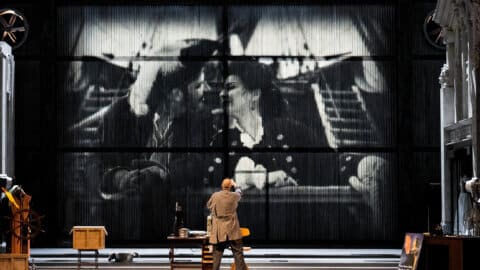
It almost goes without saying that any trace of Andalusian folklore has been stripped away. There are no postcards from Seville here, no colorful marketplaces, no billowing dresses, and no romanticized bullfighting aesthetic. The absence of tradition is thoroughly modern, but nothing more compelling has taken its place

Photo: Virginia Rota
In recent years, it has become an almost obligatory opera cliché to strip works down to their inner psychology and rid them of visual spectacle that might risk entertaining the audience. This production of *Carmen* is a textbook example of this trend.
The performance takes place in a barren, rocky landscape of concrete and sloping surfaces. In the middle of the stage lies a small, incongruous basin that never really takes on any dramatic significance.
A minimalist lighting design creates a few striking images along the way, but it is not until the finale—when the stage fades into deep blood-red hues—that the performance achieves something truly compelling visually.

Photo: Virginia Rota
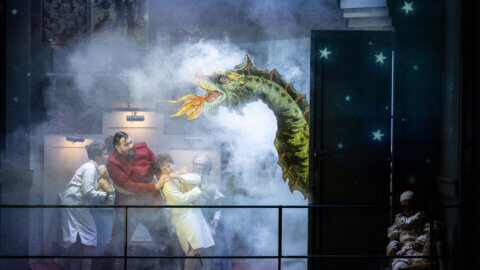
As a co-founder of Peeping Tom, Carrizo naturally incorporates dance into the opera. A group of performers constantly moves around the singers, serving as physical manifestations of the characters’ subconscious, traumas, and desires. Their bodies twist, collapse, and act out the emotions that the music is already conveying to us. This is a technique seen in many European operas these days.
And which is neither particularly innovative nor particularly revealing. On the contrary, it often feels artificial and childishly insistent. As if the production doesn’t trust that Bizet himself has already written those emotions into the score.
The production goes all out to be original, but it doesn’t feel particularly new. Carmen has been de-romanticized before. Calixto Bieito’s legendary production already stripped away the joy of life in an interpretation of the work as a brutal tale of macho culture, violence, and social decay. In Carrizo’s version, the focus shifts instead to the characters’ consciousness and subconscious.

Photo: Virginia Rota
This contrast is evident, for example, at the Arena di Verona, which boldly demonstrates why *Carmen* has become the world’s most popular opera. Here you’ll find the grand visuals, the crowd scenes, the colors, the melodies, and the overall experience. Salzburg seems more concerned with discussing *Carmen* than with telling the story.

Photo: Virginia Rota
Fortunately, there are the singers. Asmik Grigorian does not disappoint in the title role. She possesses exactly the magnetic stage presence one would expect from one of the greatest opera stars of her generation. Her Carmen is seductive, uncompromising—and let down by a misguided staging.
Jonathan Tetelman delivers an intense performance as Don José. It is not until the final confrontation between the two lead characters that the electric tension—which the production lacks for most of its runtime—finally emerges.
Perhaps the most beautiful musical moment of the evening comes, surprisingly, from Kristina Mkhitaryan as Micaëla. Her grand aria in the third act is sung with such warmth, control, and lyrical beauty that it makes time stand still. In the midst of a performance that constantly emphasizes symbolism and psychological layers, Micaëla’s simple humanity suddenly becomes the evening’s most moving drama.
I left the Festspielhaus feeling genuinely disappointed. Perhaps because expectations were so high—and the ticket prices reflected that. Perhaps because all the ingredients for a major Salzburg success were actually there: world-class stars, an elite orchestra, and one of opera’s greatest works.

Photo: Virginia Rota
The audience responded to the performance with a meager, bewildered round of applause. It’s clear that people came to see one show and got a completely different one. Three stars. A strong contender for the title of “Salzburg Disappointment of the Year.”