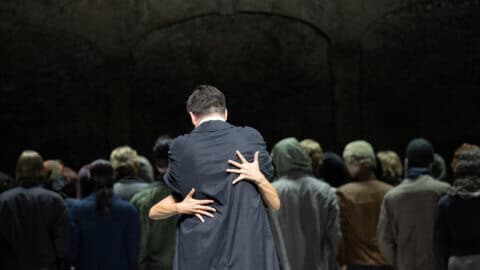
FRANCIS OF ASSISI • SALZBURG OPERA FESTIVAL
★★★★★☆

Photo: Monika Rittershaus
REVIEW: FRANCIS OF ASSISI IN SALZBURG: OPERA AS A MONUMENTAL AVANT-GARDE INSTALLATION
The Salzburg Festival did not become the world’s leading opera festival by pandering to traditionalists. Quite the contrary. For decades, the festival has championed productions that divide the audience into two camps: those who go home slightly offended, and those who go home feeling they’ve experienced something that couldn’t have happened anywhere else. Romeo Castellucci’s staging of Olivier Messiaen’s monumental *Saint François d’Assise* unquestionably belongs to the latter category.
This is not a production that stands much of a chance with the general opera-going public. On the other hand, it is an artistic expression of such caliber that it offers the most adventurous theatergoers an experience they will likely never forget.

Photo: Monika Rittershaus
One of the evening’s most wondrous highlights takes place in tableau number six on the Felsenreitschule’s 100-meter-wide stage.

Photo: Monika Rittershaus
In the center of the stage stands a group of monks in white robes. They are splattered with blood from head to toe. Prior to this, they had stood in a circle around a large white stone for several minutes, rocking back and forth on their toes with puzzled expressions as they slowly painted their lower legs blue. Earlier, Frans himself had lain face down on the stage floor with a violin strapped to his back and announced his intention to deliver the famous Sermon to the Birds.
Amid a wonderful soundscape of chirping, screeching, whistling, and clucking instruments, dead birds suddenly begin to rain down from the ceiling. First, just a few. Then hundreds. Some fall like stones. Others seem to float fluttering down through the air until the stage floor is strewn with dead birds.
Several monks enter, carrying dead swans that apparently have gone to rest after hearing Francis’s message. Shortly afterward, it is reported that flocks of birds have flown north, south, east, and west to spread the word in the directions of the cross.
“Should we do the same?” the monks ask one another. The question hangs in the air as the music fades into meditative silence.
It’s absurd, moving, and impossible to explain—just like the rest of the performance.

Photo: Monika Rittershaus
*Saint François d’Assise* is not a portrait of Saint Francis. Rather, it is a hyper-avant-garde attempt to depict his journey toward the divine. The work is described as an opera, but that term only partially captures its essence.
There is no real plot. No narrative device to take the audience from A to B. Instead, the work consists of eight tableaux that serve as independent meditations on faith, nature, suffering, community, and transcendence.
In other scenes, a completely naked, emaciated, “leprous” old man is washed with intimate thoroughness; young men are shaved with electric razors; brothers knead dough and toss flour around before bread is baked in industrial ovens on stage, and a wonderful aroma spreads through the audience.
A glowing cross is never quite finished; a stranger who turns out to be an angel appears and asks incomprehensible theological questions; a wolf, a goose, and a flock of sheep take turns wandering among the singers….

Photo: Monika Rittershaus
Messiaen’s music alternates between explosive bursts of percussion, woodwinds, and brass, and long, almost timeless passages of soaring strings. Bird calls appear throughout as musical building blocks. The French composer was a passionate ornithologist who traveled the world to transcribe birdsong into musical notation, and this is evident in nearly every scene.
“Francis of Assisi ” has absolutely no intention of rushing things. With two intermissions, it lasts six hours and twenty minutes.

Photo: Monika Rittershaus
The performance feels like a massive jigsaw puzzle in which the pieces have been tossed into the air and land in random order. They never come together to form a single, clear image. Instead, new images, associations, and questions constantly emerge.
One of the most fascinating things is precisely Castellucci’s insistence that the audience does not have to understand everything. For this Italian master director, the images are more important than the explanations. His staging is a monumental work of art in and of itself.
The stage is filled with enormous sets, hundreds of performers, rain, fire, fog, and dirt. At one point, figures rise like resurrected zombies through a stage floor covered in soil. In other scenes, the stage is transformed into something that most closely resembles a living installation at an avant-garde museum.
Throughout his career, Castellucci has worked at the intersection of theater, visual art, and religious rituals, and here it almost feels as if the form of opera is dissolving.

Photo: Monika Rittershaus
One might argue that six hours and twenty minutes is an unreasonable investment for a work without a clear narrative. One might also argue that, in some places, the symbolism becomes so obscure that it loses touch with the audience.
It’s hard to argue against artistic courage. Salzburg emerges as precisely the laboratory for big ideas that the festival aspires to be. With “Francis of Assisi,” the festival has, with 200 percent certainty, tapped into the segment that calls for uncompromising and unconventional productions.

Photo: Monika Rittershaus
Artistically thought-provoking to the core, you leave the theater without fully knowing what you’ve seen, but with a nagging feeling that the experience will linger long afterward.
Five stars for an opera that really defies categorization and, more than anything else, resembles a massive art installation disguised as a musical drama.