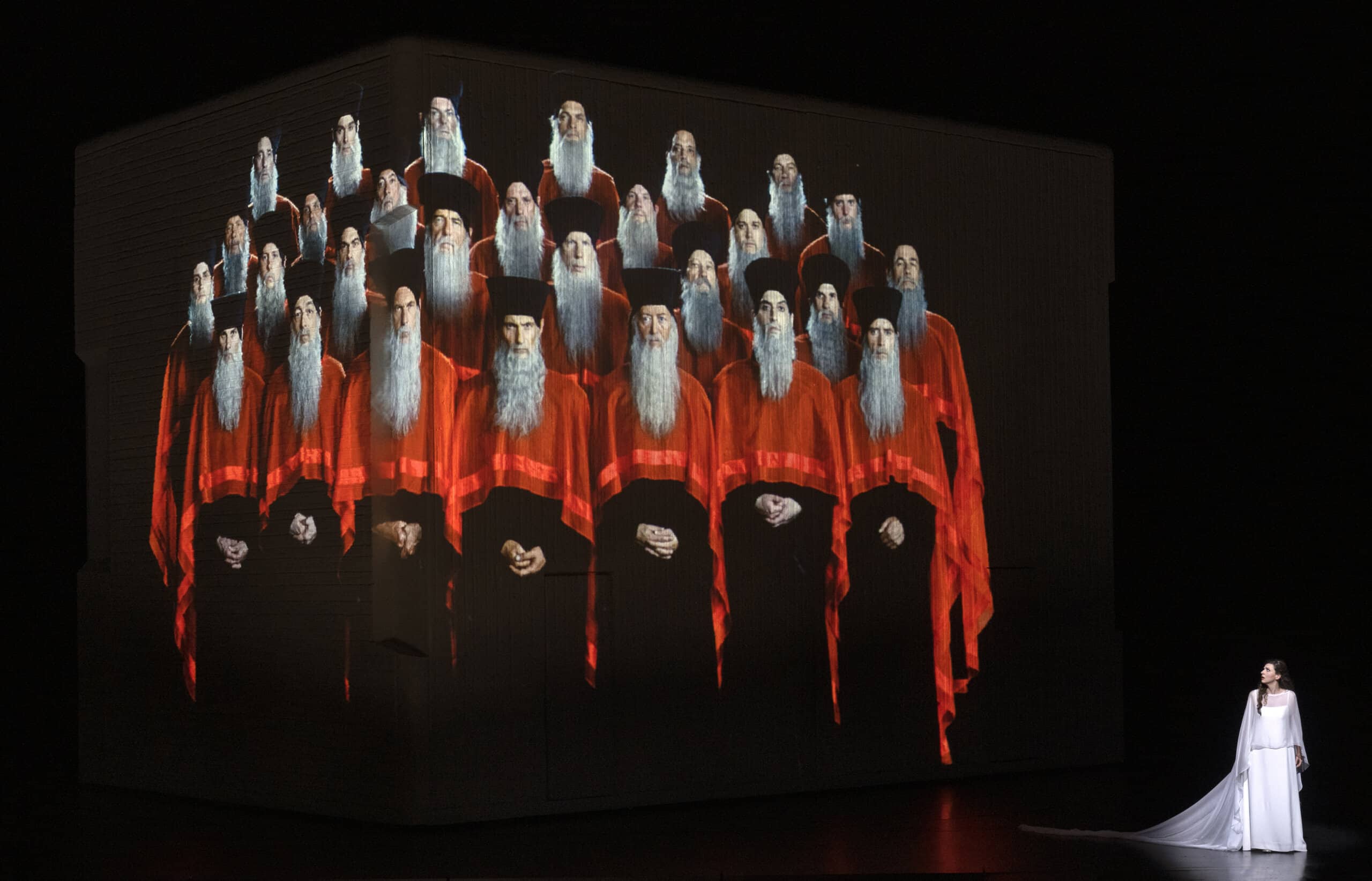
TURANDOT • AIDA • ARENA DI VERONA
★★★★☆☆

Photo: Ennevi
REVIEW OF TURANDOT AND AIDA: IN VERONA, THE PEOPLE HAVE TAKEN OPERA BACK FROM THE ELITE
The opera performed in the ancient Roman amphitheater in Verona is almost more of a tourist attraction than an actual theatrical experience. That doesn’t change the fact that, night after night, 10,000 to 12,000 audience members are treated to a spectacular reminder of what opera can be.
Both Puccini’s *Turandot* and Verdi’s *Aida* are perfectly suited to the arena’s enormous scale. Franco Zeffirelli’s productions don’t hold back for a single second. Giant golden Chinese palaces. Pyramidal Egyptian temples. Hundreds of chorus members, extras, and soldiers. Dancers stream across the stage in flowing silk or opulent pharaonic outfits. Ragged crowds in Beijing or hordes of priests and clergy in constant motion in a meticulously choreographed spectacle of total theater.

Photo: Ennevi
Everything is big. Very big. While modern opera directors often try to peel away layers of the work, Zeffirelli does the opposite. He adds more layers. Forget “less is more.” “More is more” in Verona.

Photo: Ennevi
The late Zeffirelli was both a film and opera director, in addition to his career as a politician serving in the Italian Senate. In the world of film, some will remember him for *Hamlet* starring Mel Gibson and Glenn Close (1990), *Romeo and Juliet* (1968), and *The Taming of the Shrew* the following year, starring Elizabeth Taylor and Richard Burton.
Among the three lead roles in *Turandot*, Yusuf Eyvazov is particularly impressive as tonight’s Calaf. His “Nessun dorma” is delivered with tremendous vocal power. A voice that effortlessly fills the enormous hall with its slightly sharp timbre. The audience responds with the evening’s loudest applause.

Photo: Ennevi
Liù becomes the star and emotional center of the production. Her warmth and humanity serve as a counterpoint to Turandot’s icy detachment. This is also where Puccini’s music truly touches the heart. Of course—one might almost say—for on this evening the role was sung by the outstanding American soprano Lisette Oropesa, a frequent guest on major European stages. A first-rate return performance.
The Verona production sticks to the traditional ending. The entire story is played out to the end. No modern rewrites. No ironic commentary. No alternative interpretations, as in the powerful production in Valencia, where Turandot herself ended up taking her own life.
Aida follows the same formula. The production exudes monumental beauty, with an absolutely enormous set design and a display of costumes that rivals even the most opulent blockbuster movies.
The arena format is once again the show’s greatest strength and greatest weakness. It looks fantastic. At times, it sounds less than fantastic.
At times, the musical energy seems to vanish right into the Italian night sky. The soloists struggle heroically to project their voices through the wall of orchestra positioned in front of the stage. Today, the arena uses discreet microphones and sound amplification. It’s not like in a musical or pop show, where each soloist wears a visible headset microphone. Instead, an advanced system of hidden microphones and speakers is used.

Photo: Ennevi
It is said that a Verdi tenor can easily produce 110–120 dB close to the source. The problem at the Arena di Verona isn’t the volume, but the distance. If you’re sitting 150 meters away, the details in the lyrics and the sound get lost.
For this reason, the system is used more for acoustic correction than for actual amplification. The arena’s technicians have described their goal as “enriching” the sound minimally and preserving the natural experience. At times, the volume and intensity fall short. This is an inherent condition and a built-in challenge of opera on this scale.
Even in the most expensive seats, you’re sitting very far from the stage. Still, it’s hard not to get swept up in the scale of it all and the feeling of being part of a major event. A theater performance. A soccer game. A rock concert. You get the idea.
The opera world devotes a great deal of energy to debating the genre’s relevance. Salzburg and Bayreuth interpret, update, and challenge. Verona asks: What if the audience just wants to be thrilled?

Photo: Ennevi
Zeffirelli’s productions of *Turandot* and *Aida* are almost modern precisely because they do not try to be modern. They insist that opera must also be entertainment, and that accessibility is not the opposite of quality. Perhaps the challenge for opera is sometimes that it is suspicious of what the audience actually loves.
Four stars for both productions, each of which works brilliantly on its own terms. You don’t necessarily go home with a deeper understanding of either Puccini’s or Verdi’s works. You go home with an experience.
In Verona, the people have reclaimed opera from the elite. For better or worse